Wave power plants

Wave power plants

Voith Hydro Wavegen in Inverness, Scotland is a "Center of Competence" in wave power, driving forward research and development in wave power systems. Voith Hydro Wavegen focuses on the conversion of wave energy using the principle of the oscillating water column (OWC).

Technology: Oscillating water column (OWC)

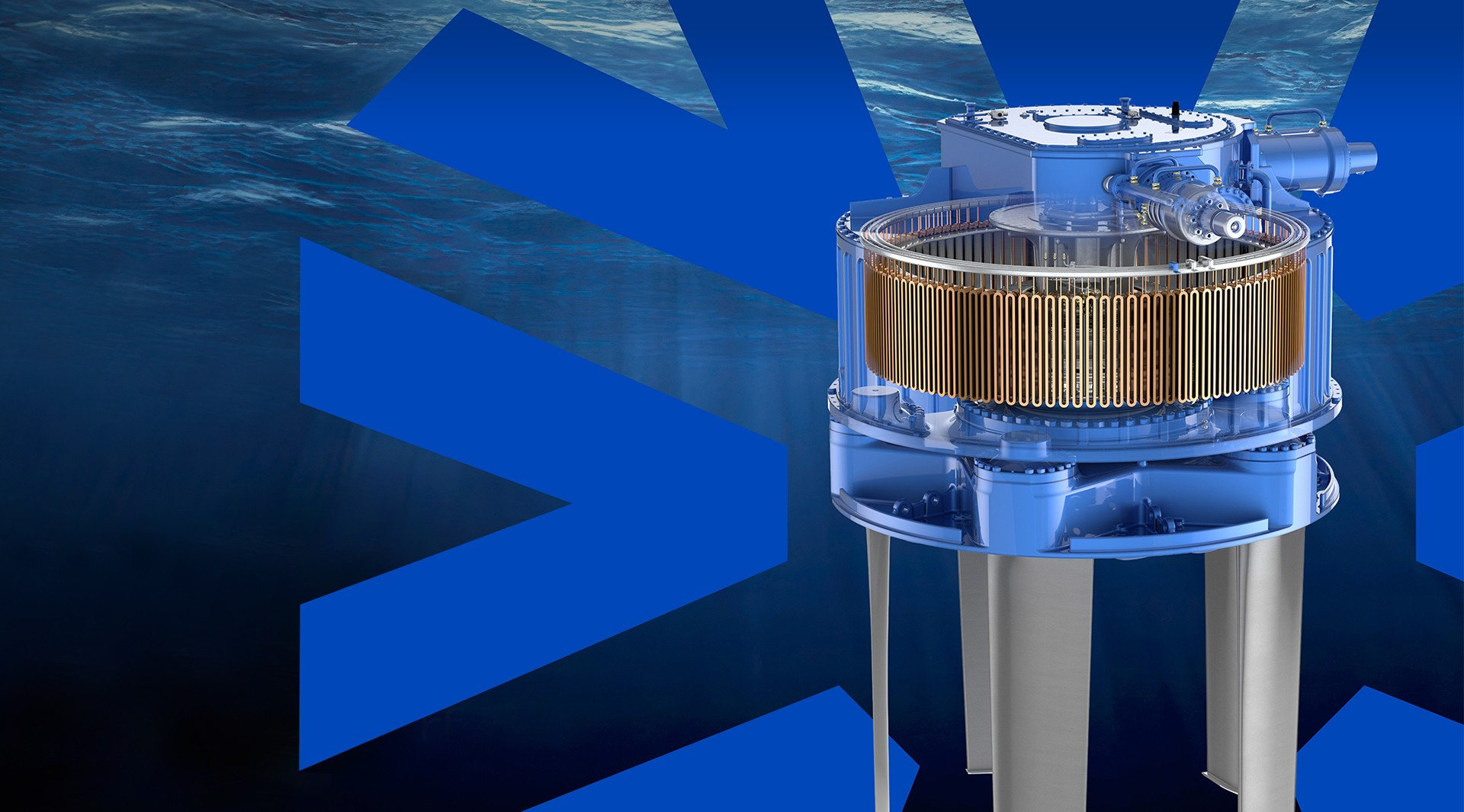
With this technology, sea water turbines do not come into contact with water. Instead, a column of air is set in motion which drives the machines. In detail, this works in the following manner: The waves spill into a hollow container which is open to the sea. This compresses and calms the air column in a so-called collector in a similar way to how an air pump works. The power plant "breathes" in and out. The pressure difference is then turned into rotary energy in a so-called Wells turbine (named after its inventor). This is in turn passed to a generator where electricity is produced.
This means that the turbine has the air periodically flow through it from both sides, depending on whether the device is "breathing" in or out. Because of the special rotor geometry, there is no need to either periodically change the blade angles or the direction of rotation. If you consider the fact that an average of some 3 million waves break on to the coast every year, it is clear that only this simple turbine design can offer maximum reliability. 

Contact

Wolfgang Maier

Head of Business Development
Voith Hydro Global

Telephone
+49 7321 37 9322

Voith Hydro Wavegen uses the oscillating water column system in three types of coastal power plants:

Shore line power plants

In a collector structure built on to the coast with an opening to the sea, an air chamber is formed in which the air is compressed and calmed by the incoming and outgoing waves. Depending on the size and the volume of the waves, such shore line power plants have power ratings from a few hundred kilowatts up to a few megawatts.

Trial system - Limpet

In the year 2000, a 250 kW trial system was brought into service on Scotland's west coast, where it has been generating electricity and feeding it into the network ever since. This plant, which has a machine unit installed on land that is driven by the energy from the sea, has a catchy name – Limpet (Land Installed Marine Powered Energy Transformer). The collector sits like a limpet. It was thus named after this sea creature.
Limpet is the only wave-powered plant worldwide to have continually produced power over the past 10 years, feeding it into the network on the Isle of Islay. Up until the end of 2011, it had been running for more than 75 000 operating hours. System availability stands at over 98 percent, and has been so continuously since 2009. This sets the global benchmark in the wave power segment.
The Limpet power plant is primarily used for testing new and optimized generations of Wells turbines. 
 

Near-shore power plants

In the same way as with the shore line power plants, a collector housing can be placed a few hundred meters from the coastline in approximately 10 meter deep water. Such plants can also be used as docks for small ships and boats. The collector housing is normally connected to the mainland via a dam. This dam provides a simple form of access to the power plant for maintenance purposes, as well as a dry and protected location for laying the cables. Depending on the size of the waves and the size of the power plant itself, nominal performance of 10 to 100 MW is possible. Thanks to the UK's feed-in tariffs, such power plants can already be operated economically nowadays.

Breakwater power plants

In this system, the power plant is integrated into a new build coastal structure, such as a harbor breakwater or a coastal protection project. This can significantly reduce the costs. At energy-rich locations, more than 10 MW in rated power can be achieved by utilizing the secondary use of the coastal protection structures.

300 kW system in Mutriku

The world's first breakwater wave power plant was commissioned in the summer of 2011 on the Spanish Atlantic coast at Mutriku. It has a nominal output of some 300 kW, and can supply around 250 households. The system consists of 16 Wells turbines, each with a rated performance of 18.5 kW. It was built into the breakwater around the harbor at Mutriku, which was re-built by the local municipality. This not only makes it possible to split the construction costs with the public authorities, but also permits the use of the same infrastructure as is already present (mains connection, access roads, etc.). This is the principal advantage of this technology.
The Mutriku power plant has been operated successfully since its opening by the Basque energy agency, EVE, and is currently the only commercially-operated wave power station in the world.